Leverage India’s health data for affordable health care: Prof. Samir K Brahmachari
‘Integrate AI, health data, science and entrepreneurship to accelerate healthcare innovation’
Trivandrum / August 16, 2026
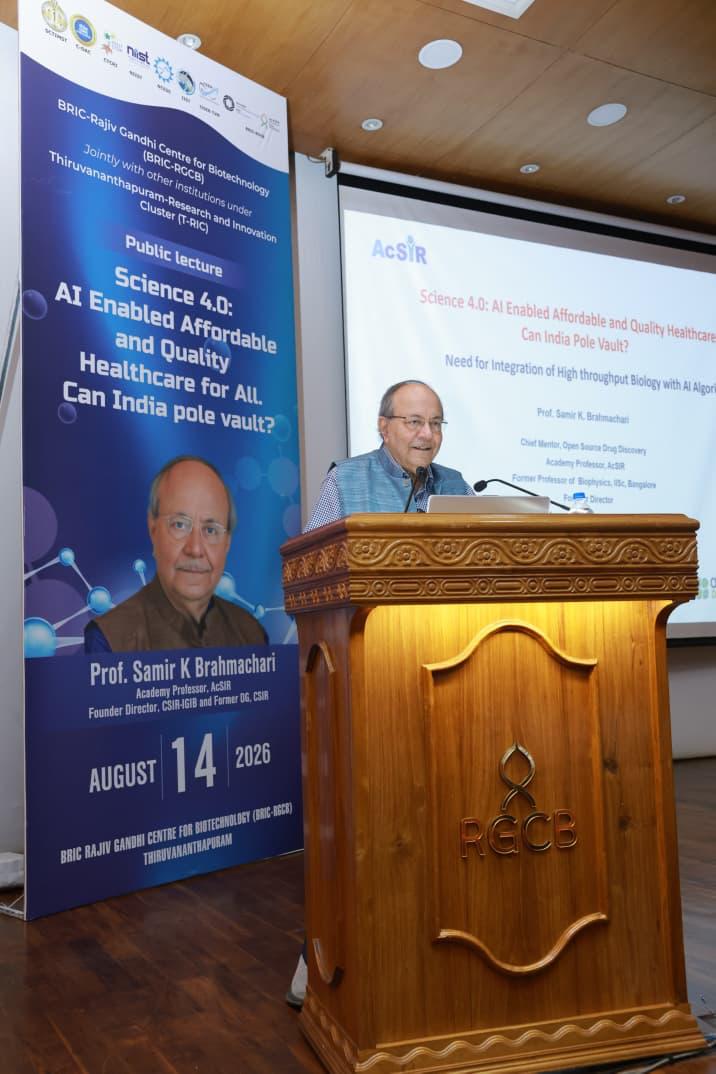
Thiruvananthapuram, Aug. 16: India should use its vast health and genomic datasets, artificial intelligence and a large pool of young researchers to accelerate drug discovery, biomarker identification and affordable healthcare, said Prof. Samir K. Brahmachari, former Secretary, DSIR, and former Director General, CSIR.
Prof. Brahmachari was delivering a lecture on ‘Science 4.0: AI-enabled affordable and quality healthcare for all. Can India pole-vault’ at BRIC-Rajiv Gandhi Centre for Biotechnology (BRIC-RGCB) here. The event was organised in association with institutions under Thiruvananthapuram – Research and Innovation Cluster.
Prof. Brahmachari said India already has large repositories of genomic, proteomic, metabolomic and population-level health data, but these datasets remain fragmented across institutions.
“The data is there, somebody has the ability to analyse it, but we must connect,” he said.
He proposed creating a platform that brings together public health datasets, hospital and diagnostic data, research institutions, startups and young researchers. Undergraduate and medical students could work with experts and AI tools on disease-specific research projects, he suggested.
Such a model, he said, could support AI-driven drug and biomarker discovery, drug repurposing, early detection of non-communicable diseases, adverse drug-reaction and drug-interaction prediction, and personalised healthcare.
Prof. Brahmachari also suggested developing disease-specific AI agents that could extend specialist knowledge to areas with limited access to healthcare. He proposed an India-specific AI system focused on Ayurveda knowledge as another potential application.
He called for India to “pole vault” in healthcare by integrating science, technology, engineering, IT, industry and entrepreneurship. India’s ability to leapfrog technological stages, from the Green and White Revolutions to IT, space technology and vaccine manufacturing, shows that limited resources need not constrain ambition. He cited India’s COVID-19 response, when around 1.75 billion vaccine doses were delivered within 10–11 months, as an example of what can be achieved through collaboration between government, science and industry.
Kerala as a test bed
Prof. Brahmachari urged Kerala to use its strong scientific and healthcare ecosystem to demonstrate what such an integrated model could achieve. He suggested developing a state-wide antimicrobial-resistance (AMR) map by bringing together research institutions and microbiology students to collect and analyse data.
He also proposed creating a virtual network or dashboard mapping the expertise available across Thiruvananthapuram’s scientific institutions. Research projects could then quickly identify and bring together the required expertise without being constrained by institutional boundaries.
Prof. Brahmachari cited his earlier open-source drug discovery work as an example of how crowdsourcing and collaboration can expand access to scientific tools and knowledge.
He said the cost of genomic sequencing has fallen dramatically through technological innovation, while drug discovery has become increasingly expensive. Open innovation and shared scientific knowledge, he argued, will be essential to make future healthcare technologies more affordable.
“Your aspiration should be far larger than the technology exists,” Brahmachari said, urging young researchers to pursue ambitious ideas and not allow conventional thinking or resource constraints to limit innovation.
Terming Kerala as the citadel of Ayurveda, he called for the reinvention of Ayurveda for the 21st century and the use of evidence-based Ayurveda for personalised healthcare. “Our scientific institutions have not invested in understanding Ayurveda,” he said.
He described the emergence of AI as “Science 4.0”, with LLM tools becoming part of research teams, and urged young scientists to develop the ability to ask better questions and work across disciplinary boundaries.
Welcoming the gathering, Dr. Beena Pillai, Director, BRIC-RGCB, said that the idea of harnessing technology to address the needs of ordinary people is reflected throughout the work of Prof. Samir K. Brahmachari.
Ends
Photo Gallery
Content
Latest PRESS RELEASES
-
International Cyber Women’s Day seminar held at Government Cyberpark
September 1, 2026
-
ഗവ. സൈബര്പാര്ക്കില് അന്താരാഷ്ട്ര സൈബർ വനിതാ ദിന സെമിനാര്
September 1, 2026
-
Infopark Cherthala hosts ‘Inforhythm 2026’
September 1, 2026