Biennale: Edam artist Nithya delves into extraordinary in ordinary and strength in vulnerabilities
Kochi / March 18, 2026
Kochi, Mar 18: From the mundane to vulnerable moments, student-artist Nithya A S delves in their nuances and subtleties. Her works in acrylic, watercolour and charcoal trace her personal journey, embedding stories in her narratives with symbols that hold viewers to pause, reflect and connect.
A painting of a hair-washing session in a beauty parlour catches viewers’ attention from the landing of the first floor at Edam, featuring artists from Kerala, in Garden Convention Centre, Mattancherry, running parallel to the ongoing Kochi-Muziris Biennale.
Nithya has captured the moment in detail—the pelvic shape of the wash basin, water, neck firmly placed, the hair curled inside, towel around the neck, revealing a bit of her black top, eyes closed. A bubble floating speaks of its light and fleeting nature. An ordinary act of hair-washing and styling has transformed over the years in unimaginable ways.
According to Edam curator Aishwarya Suresh, “Nitya’s paintings grow from deep personal memories, but they open conversations widely familiar. Hair becomes a powerful symbol of care, trauma, beauty, prejudice, and intimacy. Through simple, everyday domestic scenes, she gently draws viewers into moments that are both tender and unsettling. What might seem ordinary at first slowly reveals the emotional weight that hair can carry within families, relationships, and private spaces.” Hair is a recurring motif and metaphor in Nithya’s work.
“I have heard of people holding on to locks of hair, even wearing them in lockets. I was obsessed with hair from teenage, may be because of its cultural and traditional aspects of femininity. At one point, I cut my hair and was rebuked at home as if it were a crime, calling to mind control and subjugation, even to the hijab wearing and Jina uprising in Iran,” said Nithya. She has exhibited five paintings done while pursuing Bachelor of Fine Arts (BFA) in College of Fine Arts Kerala, Thiruvananthapuram.
“I thought it would be liberating and transformative, but felt miserable. It was difficult to come out until it slowly found a place on my canvases,” pointed out Nithya, who is currently into the Master of Visual Arts (MVA) at M S University, Baroda.
At the other end is a larger painting of hair washing in a bathroom. From the blue tiles, the violet curtain on the steel rod, the cistern, the soaps in the dishes on the wall, the head below running water being washed by another girl with hair knotted above and red thorthu (Kerala towel), draped like an apron over a green gown, both balancing themselves, a hand gripping a bucket with clothes soaking inside and a portion of a rectangular wash basin above. Its depth is reflected in the gestures, bright colours and feelings of love and care.
“It’s my friend washing my hair. During my hostel days in BFA, I encountered girls helping one another, in uninhibited states, bringing out their best self,” said Nithya.
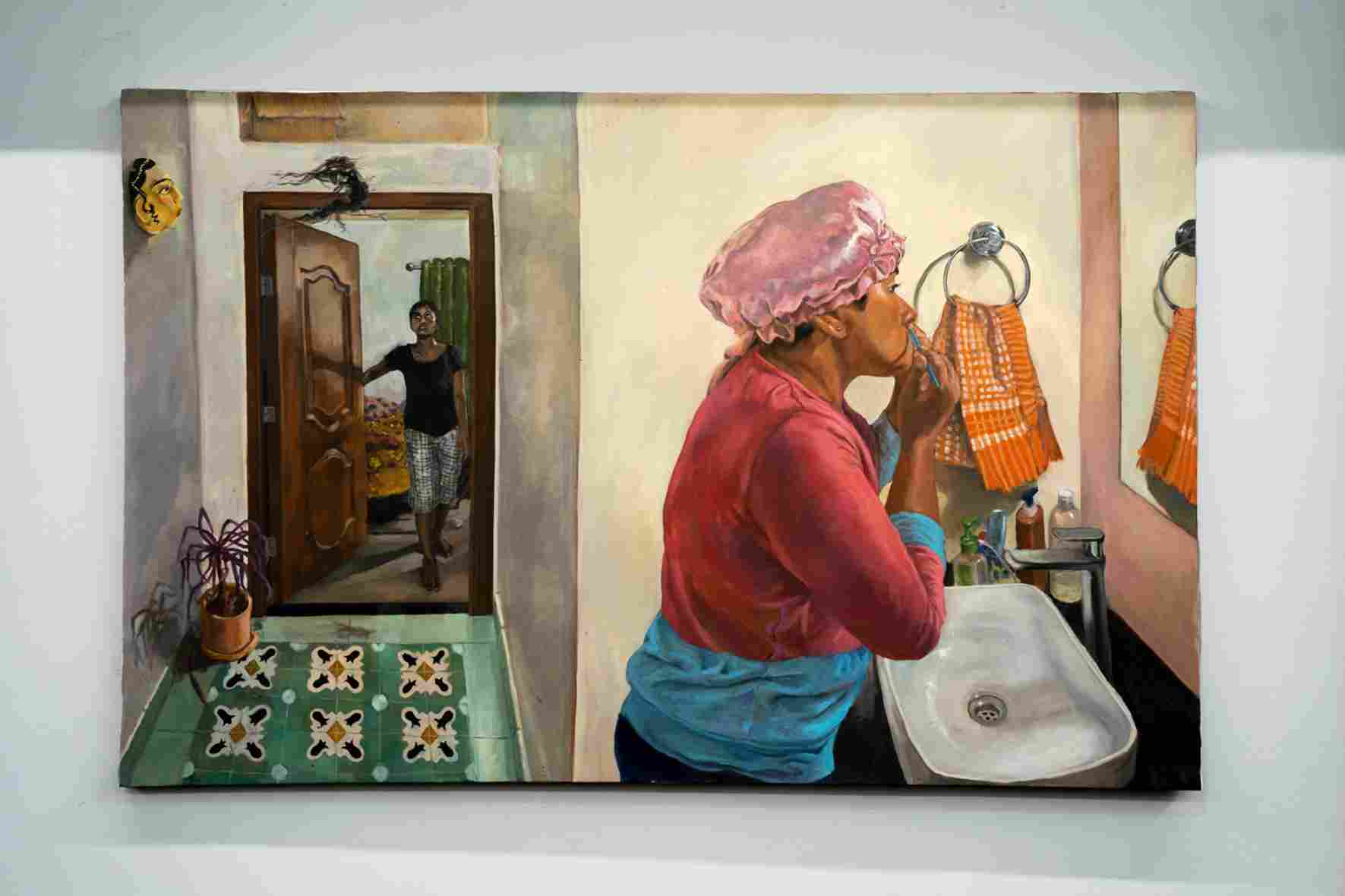
She raises thoughts on shaving hair, even pubic hair. A canvas depicts a youngster shaving her upper lip hair gazing into the mirror above the basin and another girl at the doorway looking up at the two-faced mask-like figure and a patch of hair floating nightmarishly.
Another frame looks surrealistic, a veiled dream-like feel, nude, almost in a foetal pose, head down as if prostrating on the sofa, hands between her legs and palms on her sole with a dragonfly on it. On one side a plastic bubble stick draws attention and a console and book on the other; taking viewers gaze to the shape of the chairback, the fragile lace and a chunk of the round cake eaten up.
“It’s a vulnerable moment, a kind of subversion, an unconventional way of looking at things, a way of getting out of the conditioning we are exposed to,” she said. So is the other work of a youth reclining on the floor, her legs bare in shorts and top, their cut, pattern and images and the props around suggesting much.
Nithya’s compositions, colours, style, forms and images are layered and striking, spurring viewers to compare human anatomy with shapes of objects abounding with connotations.
In her earlier charcoal work, the artist brings alive a kitchen work area with a hen and chicks around in a large kitchen bowl, its black tail feathers sticking out hair-like, and a woman tending to them, a broken head of a doll in one hand and its body in the air; a sack of coconuts in one corner, yam in another and a basket in yet another, full of symbolism and narratives. It speaks of women manoeuvring with loneliness, emotions, and challenges in all her roles.
ENDS
Photo Gallery
Content
Latest PRESS RELEASES
-
International Cyber Women’s Day seminar held at Government Cyberpark
September 1, 2026
-
ഗവ. സൈബര്പാര്ക്കില് അന്താരാഷ്ട്ര സൈബർ വനിതാ ദിന സെമിനാര്
September 1, 2026
-
Infopark Cherthala hosts ‘Inforhythm 2026’
September 1, 2026