Kochi Biennale Foundation makes major accessibility push across key venues
Kochi / March 2, 2026
Kochi, March 2: The Kochi Biennale Foundation (KBF) has significantly expanded accessibility measures this year, reaffirming its commitment to making India’s largest contemporary art exhibition inclusive and barrier-free. In a landmark step, six key venues have been made accessible to differently abled visitors, embedding inclusivity into the very fabric of the biennale experience.
Kochi Biennale Foundation’s push for accessibility was coordinated by KMB junior production assistants Neeraj B and Aysha Manna, whose academic research project evolved into a hands-on accessibility initiative. Through detailed site studies, design interventions and practical modifications, accessibility coverage now extends across major venues including Aspinwall House, Pepper House, Cube Art Spaces, Armaan Café, and Island Warehouse. The result is approximately 75 per cent accessibility across key exhibition sites, enabling wheelchair navigation and barrier-free movement for visitors.
“The Foundation’s approach reflects a clear institutional shift, treating accessibility not as an afterthought but as a core principle that drives cultural production. As a truly people’s Biennale, inclusivity is central to our curatorial and production framework. In this edition, we were fortunate to align the academic work of two dedicated students with a critical operational need - an effort that ultimately enhanced the overall accessibility for our visitors,” said KBF CEO Thomas Varghese.
“Accessibility is a big issue,” said Neeraj and Aysha. “We are still in college, and this was our project, but we wanted to tailor it to be useful for the biennale. It is called the people’s biennale, so everyone should be able to experience it. Our goal was to ensure that a differently abled person using a wheelchair could enjoy the biennale just like anyone else.”
The impact has been immediate and deeply felt. Anaida Stanly, a differently abled sand artist, shared that she was able to fully experience the biennale for the first time because of the new measures. According to the students, her response underscored how meaningful such interventions can be for those historically excluded from cultural spaces.
Jocelyn Landoys, a French traveller, described the accessibility measures as truly remarkable. "This is my third visit to the Kochi-Muziris Biennale, and as a wheelchair user, I was truly impressed to find that I could access every area within Aspinwall House, Pepper House, and the other venues. The volunteers were incredibly helpful and charming throughout my visit. While we have a rich art scene in Europe, the exhibition spaces here are truly unique, and Kochi is a magnificent city. I will certainly be sharing my experience with the accessible travel community in France," said Jocelyn Landoys.
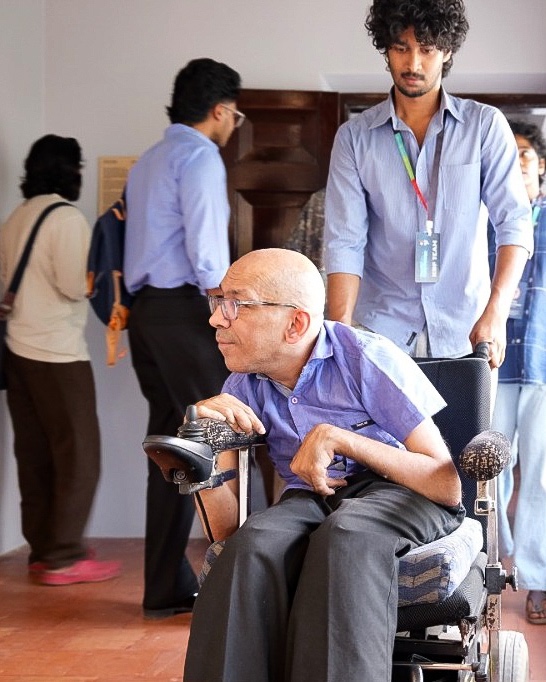
For Paresh Palicha, an art and cinema enthusiast from Kochi who has cerebral palsy and has attended every edition since the biennale’s inception, this year marked a turning point.
“I have been visiting Aspinwall since the beginning, but earlier I could not see the biennale properly due to accessibility issues,” he said. “This was the first time I could move freely and experience everything. I even went to Willingdon Island and saw artworks there because of the accessibility.”
One particularly memorable moment was reaching the balcony at Aspinwall House for the first time to take in the sweeping view of the sea, an experience previously out of reach.
“It is a very good initiative,” Palicha said. “Accessibility like this should be made available in other venues and public spaces as well.”
ENDS


Latest PRESS RELEASES
-
International Cyber Women’s Day seminar held at Government Cyberpark
September 1, 2026
-
ഗവ. സൈബര്പാര്ക്കില് അന്താരാഷ്ട്ര സൈബർ വനിതാ ദിന സെമിനാര്
September 1, 2026
-
Infopark Cherthala hosts ‘Inforhythm 2026’
September 1, 2026