Biennale artist Monica de Miranda’s Earthship 2025 raises cultural, environmental, socio- political dialogue
Kochi / March 12, 2026
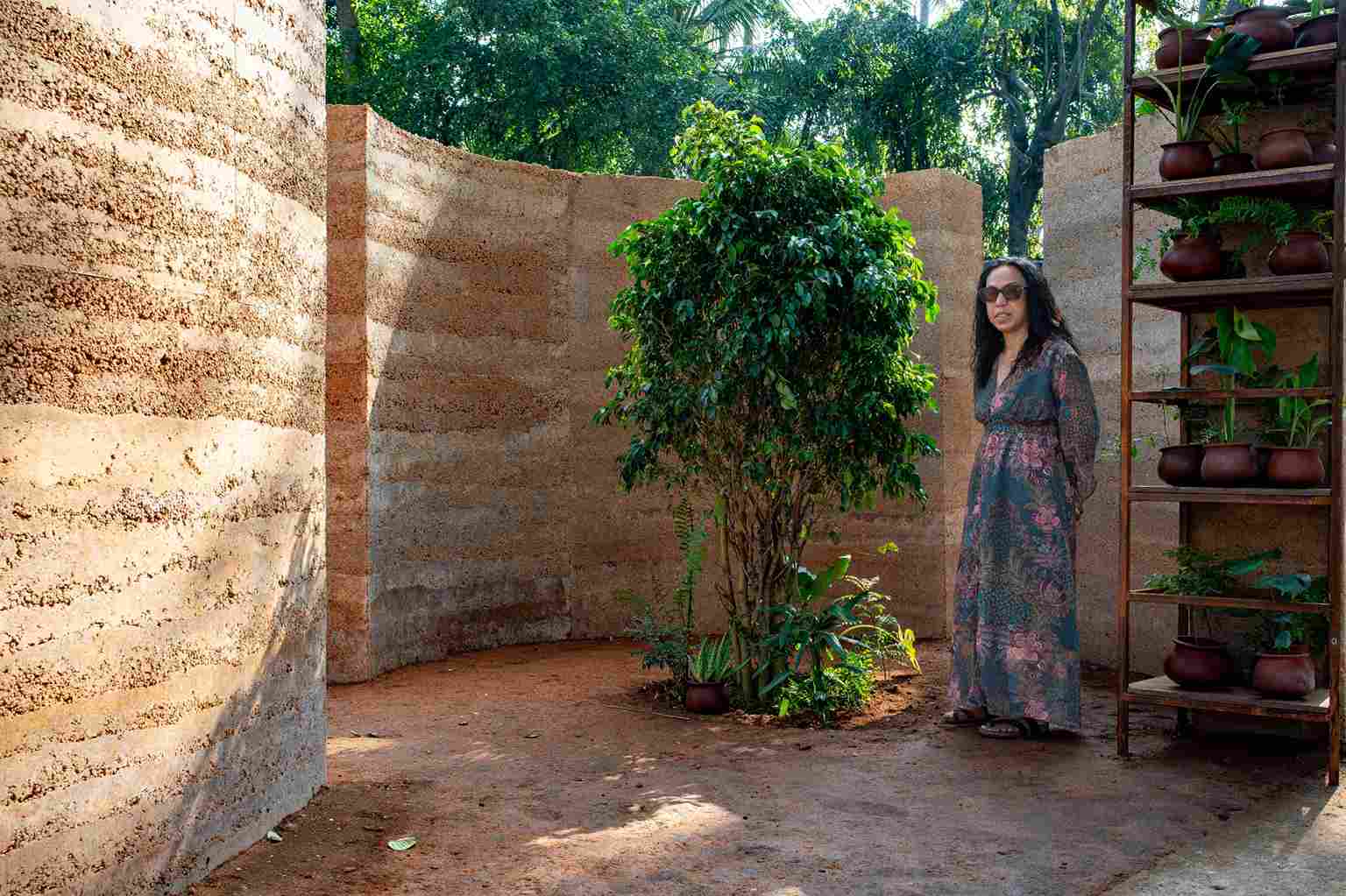
Kochi, Mar 12: Some visitors are seen seated inside lost in thoughts, some talking in the comfort of the medicinal plants and seed beds, and some just relaxing in the S-shaped hidey- hole-like earthen structure, on a triangular platform in the historical Aspinwall House Garden, Fort Kochi.
There is something more that is quite engaging for the visitors. Birds perch on the walls. It’s also a favourite space for a pair of kittens growing along with the ongoing Kochi-Muziris Biennale (KMB). Visitors pat and pamper them, a ritual they await. It’s a space to pause, ponder and commune with nature; a space for performance art and cultural exchanges.
“This is exactly what I had in mind. It’s a cultural stage, engaging with the audience, inviting them to become part of it. It’s more like a hallway of a house without a roof, with many entrances where people can rest, reset and exchange views,” said Portugal-based multidisciplinary artist Monica de Miranda about her land art, Earthship (2025). It’s a place for organic matter, nurturing and bringing people together, a community; an escape from commercialisation.
For the biennale, Monica presented ‘A New Alphabet’ in which participants gave new sounds for each letter. “The performers, mostly art interns, delved a bit into classical music and rendered different ragas. I was just a facilitator and let them explore themselves and be themselves,” Monica said. Her installation was an ideal stage for Berlin-based Butoh dancer Yuko Kaseki as well.
Earthship is about understanding the blessings of Nature and strengthening one’s bond with it. This huge site-specific installation is made of iron, wood and rammed earth adorned with iron ladders and stands for plants, based on local expertise on material and medicinal plants.
“I want visitors to feel the elements of nature, look up while climbing the ladder and see clouds or blue sky, feel the cycle of the moon, the stars and the sun. One’s body is affected by the natural environs and built spaces. I have experienced the joy and collective memories when I touch the soil for work or watch the magic of nature,” she said, hinting that such spaces are fast disappearing owing to development. Besides, technology makes it easy to remain indoors, which are spatially repelling to the body. Monica believes nature’s blessings and its art kindles senses and uplifts mind.
“Just as environmentalist Vandana Shiva addresses earth as a living maternal force, I consider this structure as a mother and all that emerges there are the children on their own journey. Earth, as a feminine form, blesses her children with abundant food, energy, air, water and shelter experienced best when one lives in harmony with her,” she said.
The triangle is layered with meaning in different traditions, it’s the symbol of creation; the Holy Trinity; a connection between earth, sky and humanity, a balance with nature or Mother Earth.
“The soil holds a lot of memory. It is older than civilisations and connected to humankind since then. It’s a site of resistance, regeneration embedded with stories, traumas, and possibilities of renewal. I love to explore the material. Soil is an actor, a protagonist in my work with all the elements of nature, of our life, and remains the same even when the seasons circle round creating awe-inspiring changes,” said Monica who researches into earth, ecology, and decolonial thoughts besides the monoculture of the Global North that poses threat to environs mainly soil pollution.
Referring to The Earthly Community by Cameroonian historian Achille Mbembe on colonialism of infrastructure, she points out that that harnessing the force of water, wind, metals, fuels, or radioactive materials through machines and of the computational world with no room for natural and organic environments will have dire consequences on the planet. It will lead to human powerlessness in the face of natural calamities and pandemics.
Monica questions artificial intelligence, artificial mind, artificial nervous systems and politics of automated organisation and of governments by capture through her work.
Monica’s Earth art is way to strengthen one’s bond with nature, explore indigenous knowledge in liberating ways, and raise awareness about environmental issues that affect earth and its inhabitants, struggles of colonialism, resistance, a way to challenge historical narratives and celebrate cultural and biodiversity.
ENDS
Photo Gallery
Content
Latest PRESS RELEASES
-
International Cyber Women’s Day seminar held at Government Cyberpark
September 1, 2026
-
ഗവ. സൈബര്പാര്ക്കില് അന്താരാഷ്ട്ര സൈബർ വനിതാ ദിന സെമിനാര്
September 1, 2026
-
Infopark Cherthala hosts ‘Inforhythm 2026’
September 1, 2026