KMB artist Kulpreet Singh’s work a narrative of ground realities of agrarian, ecological and social fractures
Kochi / March 15, 2026
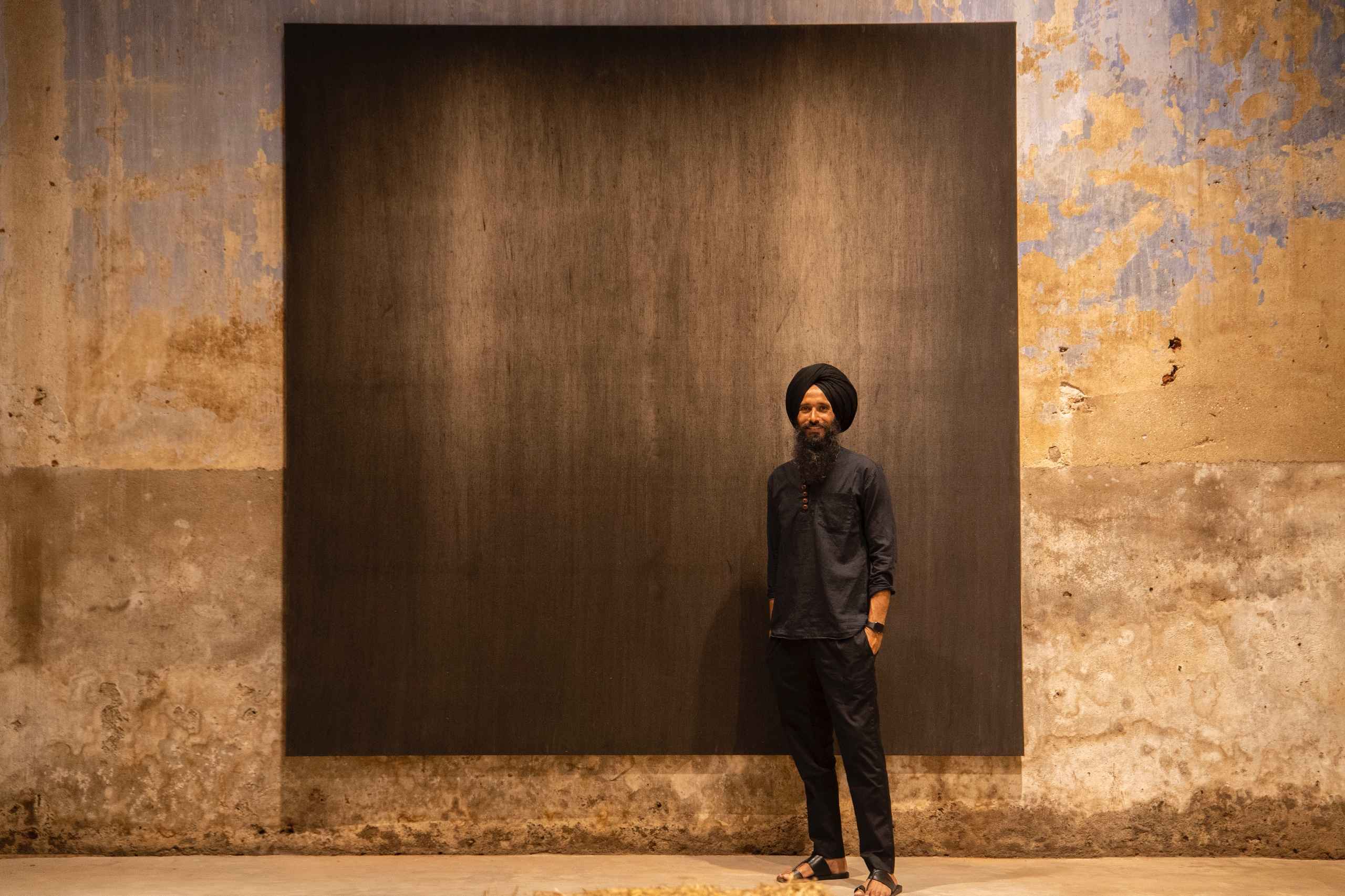
Kochi, Mar 15: The room feels like a sooty field. A dark and dreary air envelops the space in Anand Warehouse, Bazaar Road, Mattancherry. Bales of paddy straw placed here and there serve as seats when a film sheds light on the farmers’ plight and ground realities of interconnected ecologies. Viewers witness artist Kulpreet Singh, fellow farmers and friends in white running with long canvases trailing behind.
Patiala-based Kulpreet Singh’s work, Indelible Black Marks (2022–ongoing), triggers dialogue on the farming practices before and after the Green Revolution with its roots in Punjab, his home state.
The film is a large canvas of farming histories of the Green Revolution and its consequences on larger life. It starts with Kulpreet pocketing the ashes of stubble burning, a farming practice to prepare the fields for the next season of crops. Amber sparks spread across the endless rows of stubble crackling its way against the backdrop of sounds of ambulance sirens, horns, vehicles, planes, industrial noises, protests, attacks, cries of farmers, wars, explosions, violence.
Thumping and panting, Kulpreet and group are seen charging ahead like protestors along the rows of fire with long canvases trailing behind them, shroud-like.
“The canvases trace the cycles of violence we live within — against land, farmers, air, and water. What we see as smoke or ash is never isolated; it reflects wider systems of pressure, imbalance, and neglect. This work moves beyond the singular narrative of stubble burning to speak about the interconnected ecological and social fractures of our time. I invite viewers to look closely, to listen with their eyes, and to sense the quiet tensions and histories held within the surface,” said the filmmaker.
The air becomes cloudy and the images turn fluid and wavy as if raining and flooding. The sound of water is juxtaposed with the sight of fire as the group keeps running across the sparks amid a knell. They form a line which turns oval ringing in images of ploughing or a womb followed by recurring blackened dead images, of birds, trees, wolves howling. Police sirens screech, the runners captured, sound of bullets heard and farmers lie in state against the backdrop of Gurbani chant.
“The Gurbani line ‘Pavan Guru, Pani Pita, Mata Dharat Mahat’ resonates deeply here as a way of understanding the world — not as resource, but as relationship. Air guides and sustains us, water nurtures us,” he said, adding that it is a grim reminder of a future where global warming, flooding and pollution pose challenges.
The film ends with Kulpreet pocketing the ashes from the fields. “Our minds are like pockets — whatever we fill them with is what emerges. If they are filled with ash, only ash will come out. Ash is reality; it is the transformation of life, its return to the soil. Ash is pure — a reminder of mortality. We must fill our inner pockets with clarity, compassion, and conscious action. What we need is a humane revolution — a slowing down — to imagine a more just and gentle society,” he said.
The film is augmented by the soot-ridden paintings with burnt stalks. “I do not see farming and art as separate. A farmer cultivates for humans and other living beings and the unseen networks of life within the soil as well. Because of my roots in farming, I approach art with the same spirit of seva — service for collective well-being,” he said.
The practice of langar (community kitchen) continues as a living example of equality and care. Today, however, the massive production of rice and wheat has disrupted the natural rhythm of the soil. Large-scale monocropping, synthetic fertilisers, pesticides, and intensive irrigation have polluted land and water while depleting groundwater reserves. Coupled with inadequate institutional support and difficult policies, farming is becoming increasingly precarious, he said.
“Farming is a spiritual act. Farmers revere the earth as a living mother — the soil that germinates the seeds of sustenance, celebrated in harvest festivals. It is not easy to cultivate such vast stretches of land. Even in many developed countries, stubble burning persists because viable alternatives remain limited,” he observed.
ENDS


Latest PRESS RELEASES
-
International Cyber Women’s Day seminar held at Government Cyberpark
September 1, 2026
-
ഗവ. സൈബര്പാര്ക്കില് അന്താരാഷ്ട്ര സൈബർ വനിതാ ദിന സെമിനാര്
September 1, 2026
-
Infopark Cherthala hosts ‘Inforhythm 2026’
September 1, 2026