KMB: Artist Utsa Hazarika shows solidarity with victims, oppressed and displaced through Yantra (32° N/ Horizon)
Kochi / March 17, 2026
Kochi, Mar. 17: Against the backdrop of authoritarianism, hate, enmity, vengeance and wars, US-based artist Utsa Hazarika’s Yantra (32° N/ Horizon) (2025) at the ongoing Kochi-Muziris Biennale (KMB) shows solidarity with the victims, oppressed and the innocent.
The work is an adaptation of the Jantar Mantar and its Samrat Yantra in New Delhi, the eighteenth-century observatory used to gauge time, orientation, latitude and seasons based on the celestial bodies, always moving in harmony.
The scale of the sculpture and its element of surprise in the courtyard of Pepper House, Fort Kochi, amaze viewers.
Utsa has set up the steel gnomon with mirror panels at vantage points such that viewers can see the Kochi horizon while looking down from the landing of the steps. The work invites them to explore, pause and reflect about times past and present.
“This is a bigger site-specific version of my first sculpture exhibited in Socrates Sculpture Park in New York in 2024. I have placed the arc inside connecting my outdoor and indoor works that narrate Kochi’s historical, political, and diasporic movements and that of the world,” she said.
It’s a journey through Kochi’s 4000-year-old history, trade and migration; its influence on other countries, the colonial invasion, oppression, displacement, resilience, and survival, she pointed out.
From the courtyard the view of the horizon stretches across lands connecting each, layered with histories. It reflects the seafaring days of yore when horizons spread hope and marked movements of life and goods and later to colonisation and its consequences. The Yantra is a mute witness to them.
At another level, Jantar Mantar in Delhi is a site of resistance “Jantar Mantar is a symbol of protest against atrocities and injustices,” said Utsa.
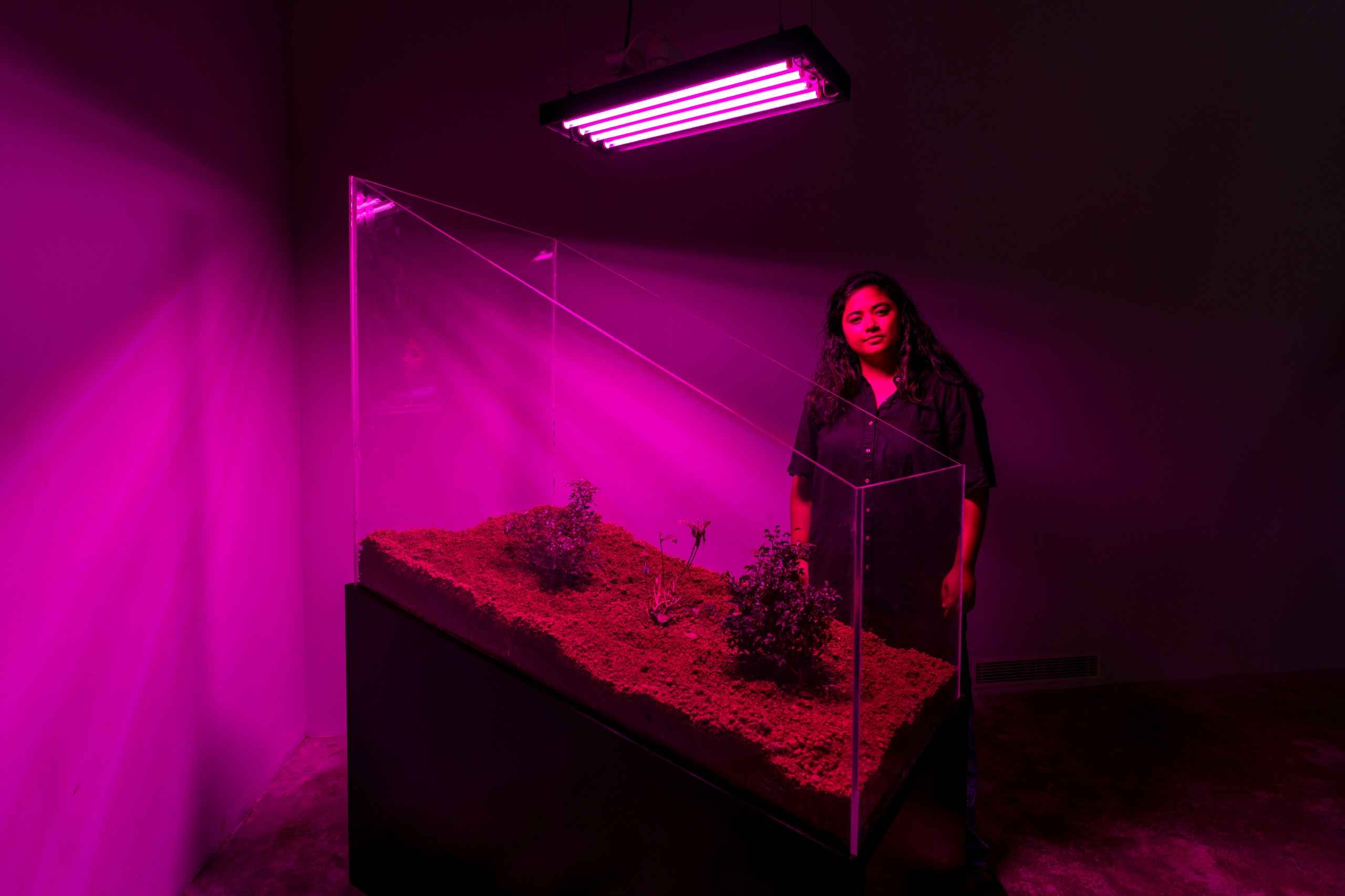
As one enters the room, the steel arc connecting two walls with the bottom firm on the floor forms am enclave where two night-blooming jasmine plants can be seen. A sun-like light moves very slowly lighting up the semi-circular structure.
“It holds the names of political prisoners in India in Morse code, recalling the days of secret communication defying censorship,” Utsa said. Propping this concept up is Bloom (10°N/28°N) (2021–ongoing) with the jasmine plants in vitrine, set to the latitudes of Kochi and New Delhi, marked by surveillance, control and tension.
With the KMB entering its last month, the jasmine has started blooming kindling sensory memories. “Smell is something that cannot be contained,” Utsa said.
Towards the left side of the room, India 1492 (2021–ongoing) lets viewers trace the days of the past from the archival maps, from the time navigators set foot in Malabar and how the wealth of the land and its culture beckoned people from near and far. What began as friendly trade and exchange slowly shifted to exploitation, extraction, oppression, capture, cruelty, and destruction as more people set foot on the soil changing geographies and histories of the country, of diaspora, of fragmented identities, of fluidity of cultural exchange.
A little away on the other wall, the video, We Cannot Let Go of This Earth (2025), speaks for the indigenous people in regions around Odisha holding on to their land, their sole means of livelihood from the clutches of mining companies. The video showcases the wealth of the land, sustainable way of life and the challenge they encounter each day implicating the viewers at every turn.
“My art is a mirror to the atrocities around provoking thoughts and talks. This is part of my ongoing research into indigenous rights,” the artist explained.
Utsa’s art links the scientific, political, and spiritual. “The Yantra and the steps symbolise higher states of consciousness by aligning the body, mind and soul through meditation,” she said.
Ends

Latest PRESS RELEASES
-
International Cyber Women’s Day seminar held at Government Cyberpark
September 1, 2026
-
ഗവ. സൈബര്പാര്ക്കില് അന്താരാഷ്ട്ര സൈബർ വനിതാ ദിന സെമിനാര്
September 1, 2026
-
Infopark Cherthala hosts ‘Inforhythm 2026’
September 1, 2026