Honouring Nature’s bounties through the power of shared work and giving
Kochi / February 26, 2026
Kochi, Feb 26: A simple gesture of sharing a meal can fill one’s soul, strengthen ties, build friendship, bridge divisions, erase inequality and spread warmth and harmony, believe artist Bani Abidi and architect Anupama Kundoo, both based in Berlin, Germany. Such moments of love and gratitude are blessing for the giver and receiver, more so when the experience is complemented by the subtle ambience.
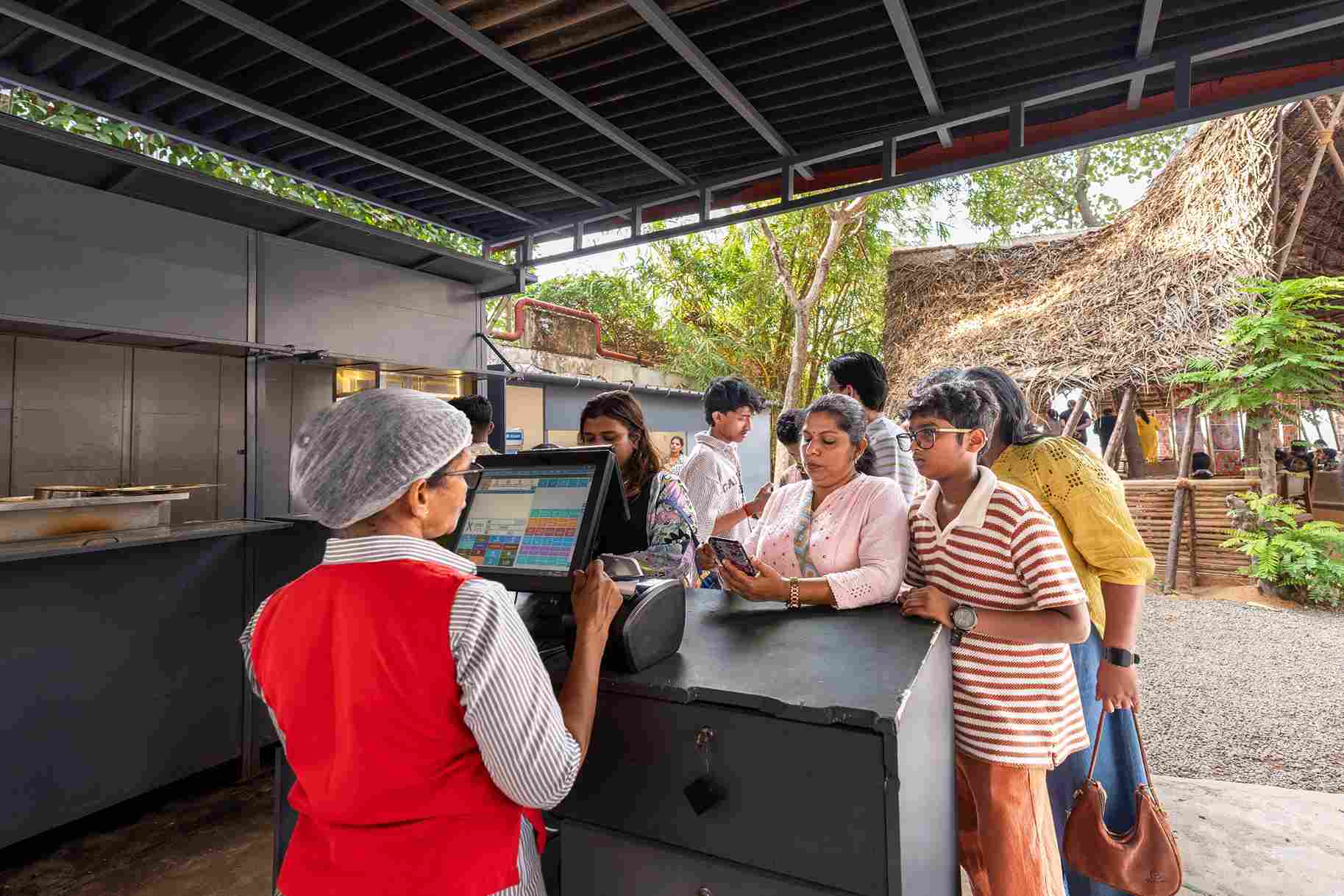
Each detail in their work, Barakah 2025, a union of art, architecture, food and service, brings out a flow of blessings from nature and people through coexistence and kind deeds. ‘Barakah’ in Arabic refers to blessings, transmitted from a sacred place or saints in abstract or visible ways. For the sixth edition of the Kochi-Muziris Biennale (KMB), Anupama from Pune has created a cosy dining space with Bani from Karachi adorning the tables with a dastarkhan illustrating their dining experiences in Germany. Food prepared by Kudumbashree members, a part of the women empowerment programme of Kerala Government, will be served on the dastarkhan, that too in Fort Kochi, a melting pot.
“Barakah is collaborative project, a work from a conversation of two distinctly different sensibilities, between sisterhood where India and Pakistan are not represented as nations; where the commonality and the desire to create something together as one artwork really come together seamlessly,” said KMB curator Nikhil Chopra with HH Art Spaces, Goa.
The work is a living embodiment of unity in action. “Community is the essence of sustainable living,” said Bani.
“When we approached Bani, she proposed the idea of plenty that comes from the kitchen, where everyone was fed even with bare minimum, with generosity, love and care. When she proposed this idea of Dastarkhan, the extended table mat over which people commune, eat together, share ideas, stories, nourishment and aspects of their life, expressing love and solidarity towards each other, we wanted to create a context for presenting it. Thus, the idea of a refuge, a roof, a common space, a dining room, a cafe, a hangout, a rest space, a pause space, an exchange space, emerged,” said Nikhil.
As one steps into the thatched dining space, and on to the raised platform it feels still yet moving on seeing the sea. Adorned with low tables and seats with cushions on earthen, cow dung-coated floor, the space looks ancient, yet modern. It feels like a boat, especially with a corner narrowing towards the sea, and thatched walls seeming like sails. Made with unpolished round wood and coconut frond thatch, bound by coir ropes, the structure speaks of the nature’s blessings, and the use of each part of the coconut palm. “I kept the round wood intact, a reminder of the traditional raw usage before industrialisation and have used material from the place. In pre-industrial time, people made do with whatever was locally available,” Anupama said.
The space is cool and comforting. “It is about celebrating what you have in abundance, not to see the limitations. Making things for oneself, human experiments help in one’s quest for life and answer who we are,” she said.
On each table made of hard, rough palm strips lie the soft dastarkhan, in rolls fixed to the table sides. Bani’s idea illustrated by Shehzil Malik on the cloth, has much to say. Inscribed around the plate is the Persian phrase, “Give thanks, for your guest draws their daily sustenance at your table” in English and Urdu. The dastarkhan has images of two plates in different colours, one against a blue background with roses in the corners of Anupama’s dinner gathering on 8 November 2025, and another against a green background with coconut halves in the corners of Bani’s dinner gathering four days later. The floral patterns, colours, symbols and letters bordering the plate, food at the centre with the fingers on it, the spoon aside, the glass of water and reflections on the dastarkhan are layered with narratives. “This illustration of our dinner-hosting experiences in Berlin is an expression of gratitude for the opportunity to feed people,” said Bani, recalling her memories of the meal-sharing tradition on a dastarkhan at home. “We get rolls of cloth that are endless, for making dastarkhan, generally used by the Muslim community for community dinner like the langar. In the past, the money you earned was spent on cooking and sharing with all, the thought that your brethren next door will do the same when they earn their money. Today, we live in times of high capitalism,” said Bani who has been hosting solidarity dinners in Germany since the Gaza war. “Barakah is a conceptual space, an experience, rather than an exhibition,” she said.
“It is a favourite space where the third collaborator, the Kudumbashree women, organise tea, snacks, and lunch for people. It’s the coming together of women with very strong, ideas and sensibilities to create one synced project, the core of what this exhibition is,” said Nikhil.
A palate that stirs the senses, uplifts the mind, and aligns with the KMB theme, for the time being.
ENDS

Latest PRESS RELEASES
-
International Cyber Women’s Day seminar held at Government Cyberpark
September 1, 2026
-
ഗവ. സൈബര്പാര്ക്കില് അന്താരാഷ്ട്ര സൈബർ വനിതാ ദിന സെമിനാര്
September 1, 2026
-
Infopark Cherthala hosts ‘Inforhythm 2026’
September 1, 2026