Healing Room @ Biennale: Serenity in pinewood carvings and clay-tone paintings
Kochi / December 20, 2025
Kochi, Dec 20: A clay saucer brimming with rock sugar welcomes the visitor at Abul Hisham’s artwork, but a taste of his ‘Healing Room’ will first require a bow of the head. For, the entry door has an altered design that makes its arch low.
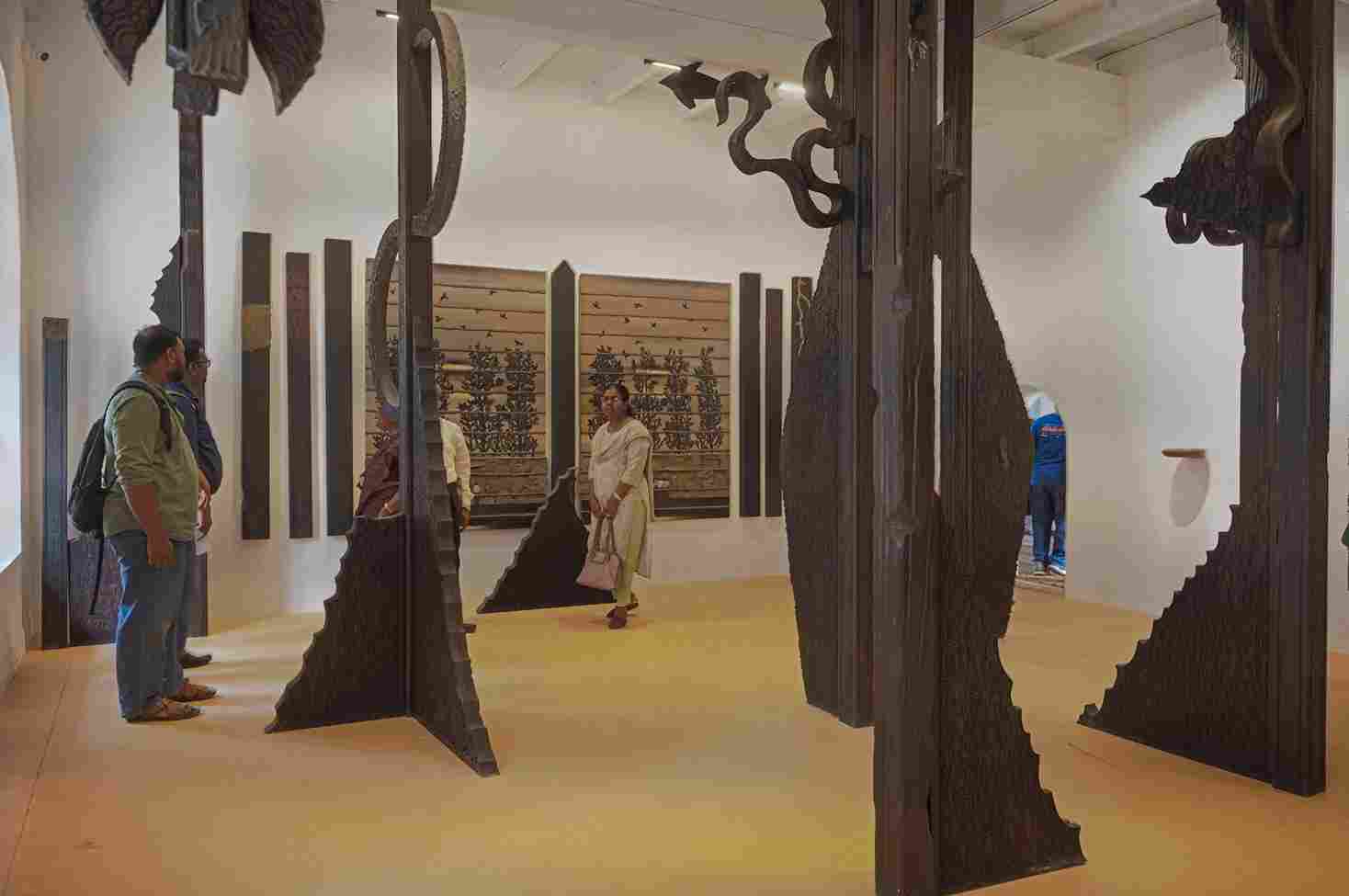
Inside is a high-ceiling square room with dark-brown pillars sculpted in an array of shapes and arranged in a way that ushers in sudden tranquillity. The concept and its execution at the three-chamber space stir all the five human senses, as one takes in the spirit of the installation at the main venue of the Kochi-Muziris Biennale (KMB) 2025.
Primarily, ‘Healing Room’ features a combination of painting and sculpture even as it carries elements that appeal to the nose, tongue, ears and tactility. The rooms are interconnected — the second has paintings, while the third displays a line-up of terracotta spouts. They function as a fountain: the water generates a constant murmur, urging the visitor to feel its coolness. Amid these is a scent wafting around.
“That is from Kashmiri oudh,” says 38-year-old Abul with a smile, not eager to disclose the exact location of the woody perfume oil that blends a set of warm spices. “I undertook long journeys as part of my thorough research around a whole range of attars before arriving at this one,” adds the Kerala-born artist who is based in Amsterdam.
The tall carvings Abul has exhibited at the 110-day biennale are a studied mix of sculpting and sketching. While a couple of wooden pillars from the white ceiling are left hanging, the others extend down to touch with the floor of light-beige colour. “I wanted those two to discontinue; not all of what we aim earn fruition in life,” says Abul, who went to the Netherlands on a residency programme in 2021 and continues to work from its capital following a project at the Rembrandt House Museum.
The wood he employed for ‘Healing Room’ is pine. “It has come from upcountry, though I bought it from Kochi after reaching here in October. I had since been working on the medium, which has a soft texture that suits sculpting,” says Abul, who mastered from SN School of Art in 2012 after graduating from the College of Fine Arts at Thrissur, close to his native Cherur village.
The wood-carvings that define the central space of the work were originally intended to be studded with the fountain, according to the artist. “I changed the idea, sensing the clutter it would make in the main room, however big,” he says, expressing satisfaction over its eventual location in the third room where the spouts are the sole sight. Titled ‘The Cracks Within’, the fountain has a concrete base with un-plastered patches. “That is deliberate. Why? The title explains it,” he says.
At a deeper level, Abul has ensured an element of devotion to each part of his work on display. The candy crystals at the entrance represent a ritual: sweets served at the start of holy rites. The main wall shows images done using acrylic and casting powder on linen and wood: of fruit-bearing trees and disproportionately-large birds. Barbed wire-like relief lines run horizontally, suggesting window-rails. “A look at the world outside may make you feel jailed — at least temporarily,” says Abul, hinting at how ‘Healing Room’ abides by the biennale’s theme of ‘for the time being’ titled by curator Nikhil Chopra with HH Spaces, Goa. The main room also shows chiselled spears, representing stifling power vis-à-vis wood-carved fishes that symbolise free movement.
In between the two rooms is a set of five clay-toned paintings showing a youngster in a state of withdrawal — either choosing to stay away from the world or unable to assert his identity. This section, named ‘Erasure’, has the images hung across one wall, reinforcing a sense of fading presence and loss — again tuning into the core theme of the biennale, which is running in 22 venues till March 31, 2026.
The festival, being organised by the Kochi Biennale Foundation, is spread across the twin towns of Fort Kochi and Mattancherry, besides downtown Ernakulam and the Willingdon Island across the creek. With its work by 66 artists and collectives reflecting a broad spectrum of contemporary practices from over 25 countries, the biennale also features parallel shows and events
ENDS

Latest PRESS RELEASES
-
International Cyber Women’s Day seminar held at Government Cyberpark
September 1, 2026
-
ഗവ. സൈബര്പാര്ക്കില് അന്താരാഷ്ട്ര സൈബർ വനിതാ ദിന സെമിനാര്
September 1, 2026
-
Infopark Cherthala hosts ‘Inforhythm 2026’
September 1, 2026