Acclaimed Ghanaian artist begins biennale run-up workshop, participants invited
Kochi / November 21, 2025
Kochi, Nov. 21: The Kochi Biennale Foundation (KBF) initiated a pedagogical workshop by acclaimed Ghanaian artist Ibrahim Mahama, under the banner of its ABC Art Room programme on November 20, while inviting more participants for the fortnight-long sessions.
The workshop being held in the run-up to the sixth edition of the Kochi-Muziris Biennale (KMB-6) commencing on December 12 is a part of Mahama’s process of creating his installation ‘Parliament of Ghosts’ for KMB exploring the ideas of memory, materiality, labour and collective histories. Mahama demonstrates on using a space even before completion or reaching perfection by binding history and memory, at the workshop on till December 5 in Anand Warehouse on Bazaar Road, Mattancherry.
Currently, 20 participants are involved in the installation-making process. Students/ young artists who wish to participate in the workshop can submit their applications via the Google Form on Instagram (bio) and website (kochimuzirisbiennale.org) at https://forms.gle/QvcGw29snv9L7oc69.
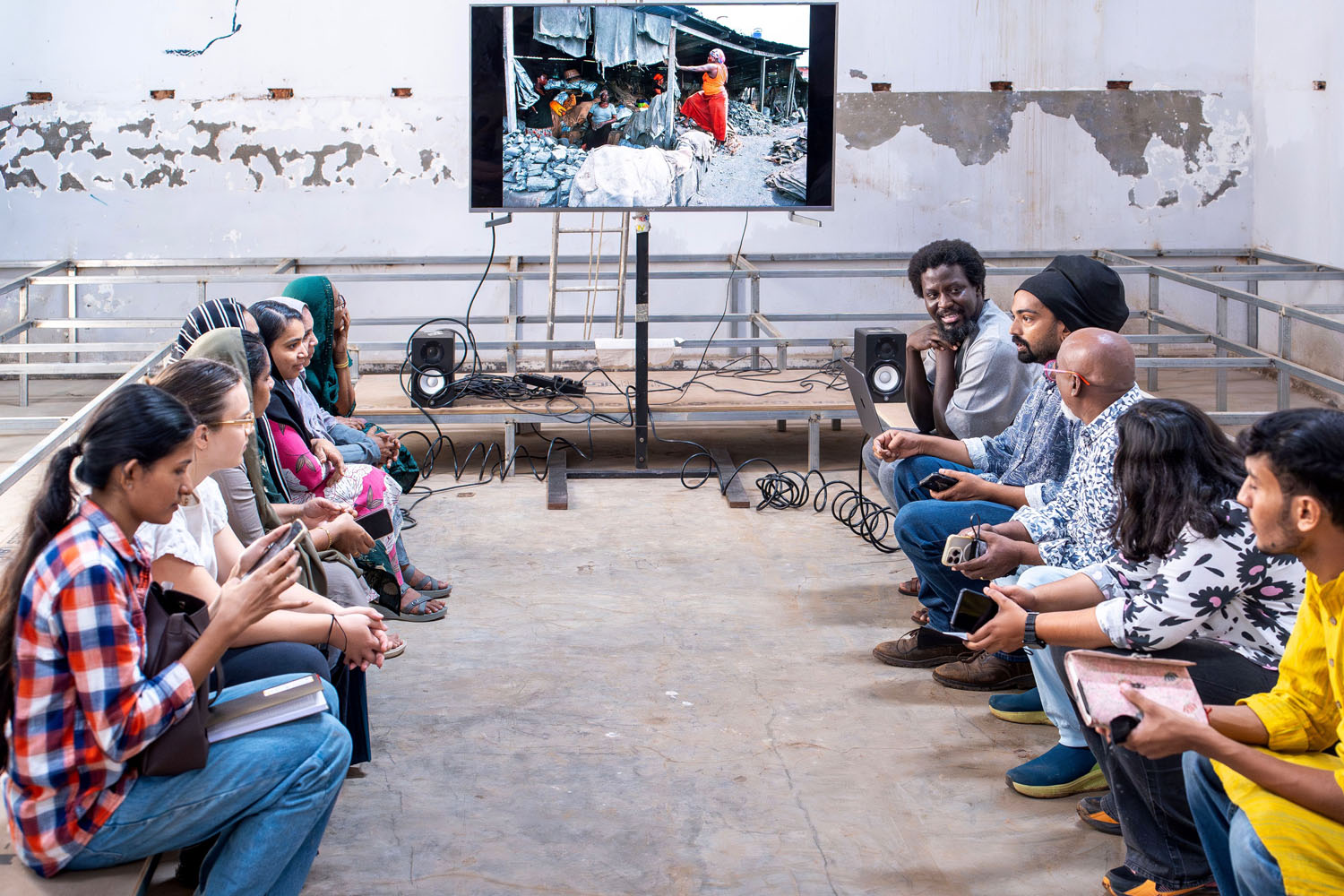
Today, the participants shared their creations with Mahama as advised and held discussions on them. With slides of some of his self-explanatory and interpretative works, he let them into his creative process, which took him years, marked by dates, places, and spaces, superimposing other images to create narratives. In the coming days, participants will be involved in repairing chairs and being part of his installation. "The wood of these chairs traces its roots to Ghana, and in Ghana, where scraps are dumped, the chairs turn into fuel for cooking, and I retrieved them by offering them firewood. These scraps have immense historical significance with which I create my art and studio," he said.
With such materials, Mahama created dialogue, explored colonialism, exploitation, labour, commodification, and inequity, discussing parallels in India.
On Thursday, Mahama pointed out that artists’ responsibility was to cultivate a process that seeks to do justice. Through a slideshow, he provided a glimpse into his creative process of making a parliament by drawing parallels to the making of his studio in Ghana, where thoughts and materials change and evolve, just as they do in life, signifying history, collective memories, redistribution, repair, and more. He linked his studio in Ghana to the first Parliament he created in Manchester. The slides depicted a quadrangle bordered by steps filled with water for construction purposes. Children are seen swimming in the pool; soon, the space turns into a school, and a local market for women of various occupations. Agrarian Ghana society comes alive in slides portraying corn cultivation in the quadrangle, followed by harvest. Then, goats occupy the space symbolising humankind’s relationship with animals. Next, dead objects are seen even as Mahama explores the potential of ghosts, how they symbolise exploitation and life rather than the living.
A few slides were on how he recreated history in his studio by laying 300000 lakh fragile soft drink bottles sourced from the shutdown factory which he bought for the purpose portraying the possibility of doing the impossible--laying them deep in his studio, projecting paintings on it, growing plants on it, people walking on where once lizards and insects used it at the closed factory. He created dialogue through the slides, particularly on the topic of repairing and repurposing vestiges of the past. A studio is not a factory, but a space for reflecting, he said.
The participants are closely working with the Art Room team and the Parliament of Ghosts project, engaging in hands-on experimentation, discussions and collaborative making inspired by the themes of the installation. Mahama’s project is supported by the Sandeep & Gitanjali Maini Foundation @sgmf2020.
ENDS
Photo Gallery
Content
Latest PRESS RELEASES
-
International Cyber Women’s Day seminar held at Government Cyberpark
September 1, 2026
-
ഗവ. സൈബര്പാര്ക്കില് അന്താരാഷ്ട്ര സൈബർ വനിതാ ദിന സെമിനാര്
September 1, 2026
-
Infopark Cherthala hosts ‘Inforhythm 2026’
September 1, 2026